
Yoga (योग): The Inquiry That Turns Inward
On the Occasion of International Yoga Day

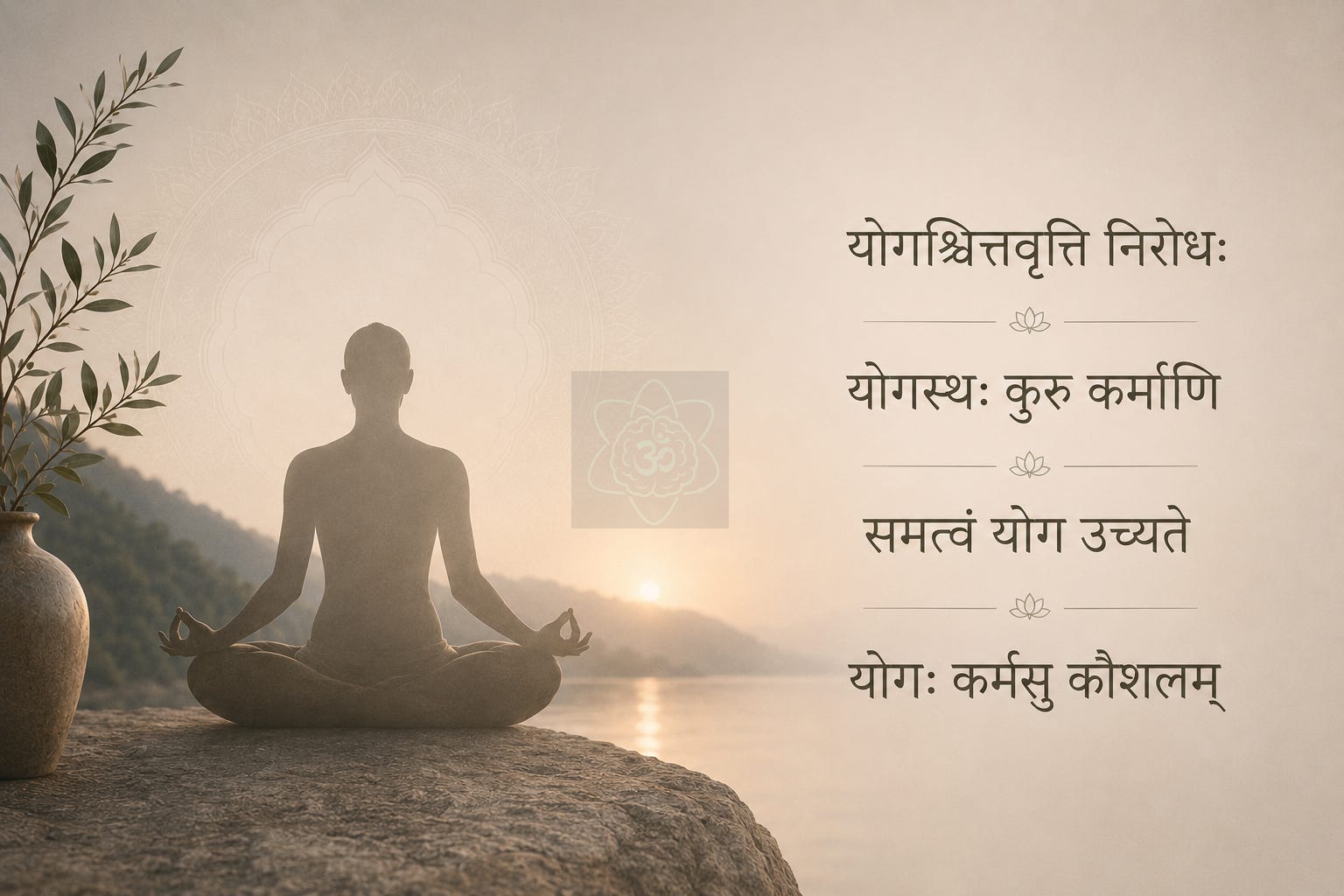
Every investigation presupposes an investigator.
This is not a philosophical abstraction. It is the most immediate fact available to any inquiry. Before the object of study is identified, before the method is chosen, before the first observation is recorded — something is already present. Something is aware. Something is looking.
Modern science has built its extraordinary edifice by refining the instruments that examine what lies outside this looking. The telescope, the microscope, the particle accelerator, the brain scanner — each extends the reach of observation into domains previously inaccessible. The results are genuinely astonishing.
Yet the instrument through which every observation occurs has remained largely unexamined.
Indian civilization eventually turned this insight inward. The discipline that emerged was called yoga. Significantly, the Sanskrit word preserves both the method and the culmination of this turning. Derived from yuj samādhau, it points to the disciplined settling of consciousness. Derived from yujir yoge, it points to the integration that such gathered consciousness makes evident.
What follows traces a single movement in two stages: first, how consciousness becomes gathered; then, what becomes evident once it is.
The Word Itself
Sanskrit rarely wastes its precision.
The word yoga derives from two classical roots, and both matter.
Yujir yoge — to yoke, to unite, to integrate.
Yuj samādhau — to concentrate, to bring into undivided absorption.
These are sometimes presented as competing etymologies. They are better understood as two perspectives on the same movement. One describes the method: the disciplined gathering and stabilization of consciousness. The other describes what that method discloses: an integration in which the apparent fragmentation of experience begins to resolve.
Samādhi is not the final philosophical conclusion. It is the mode of seeing through which what was always present becomes available to direct recognition.
Union, in this sense, does not mean joining two things that were separate. It means recognizing that the apparent separation was never ultimate. The knower and the known were not two independent substances that yoga somehow bridges. The bridge was a construction of a particular mode of knowing — habitual, reactive, fragmented. What yoga calls citta-vṛtti — the fluctuations of mind — are precisely this constructive activity taken as given.
Yogaś citta-vṛtti-nirodhaḥ. (Samadhipada, Sutra 1, Yogadasrhana)
Patañjali’s definition is clinical. The cessation of these modifications is not suppression. It is the settling of what was turbulent so that what was always present can appear without distortion. The very next sūtra completes the thought: tadā draṣṭuḥ svarūpe’vasthānam (YS 1.3) — “then the seer abides in its own nature.” Nirodha is not an end in itself; it is what clears the way for this abiding.
Three Formulations, One Movement
Patañjali establishes the mechanism.
If Patañjali develops the inward mechanics of this transformation, the Bhagavad Gītā asks whether the same consciousness can remain present amidst action.
Yogasthaḥ kuru karmāṇi — established in yoga, perform action (BG 2.48).
Samatvam yoga ucyate — equanimity is yoga. (BG 2.48)
Yogaḥ karmasu kauśalam — yoga is skill in action. (BG 2.50)
These are not softer definitions for those unable to sit in meditation. They are the same insight extended into the texture of ordinary life. When action proceeds from a consciousness no longer compulsively reactive — when the grip of identification with outcome is loosened — the quality of attention that meditation cultivates begins to permeate what is done, not merely what is contemplated.
Sri Aurobindo expresses this with characteristic precision:
“The true and full object and utility of Yoga can only be accomplished when the conscious Yoga in man becomes, like the subconscious Yoga in Nature, outwardly conterminous with life itself and we can once more, looking out both on the path and the achievement, say in a more perfect and luminous sense: ‘All life is Yoga.’” (Synthesis of Yoga, Sri Aurobindo)
Yoga is no longer confined to periods of formal practice; it becomes the conscious participation in the evolutionary movement that Nature has always been carrying forward.
This statement is often heard as inspiration. It is actually a precise metaphysical claim. If the ground of experience is awareness itself — if no moment of life occurs outside the condition of knowing — then every moment is already the field of the inquiry yoga undertakes. The question is only whether that inquiry is conducted consciously or by default.
Sri Aurobindo's contribution, however, is not simply to enlarge the scope of yoga. It is to recognize the same movement — consciousness gathering itself, then disclosing what that gathering reveals — operating not only within a single life but across the whole arc of evolutionary time, so that what Patañjali maps inwardly and Advaita discloses directly, Sri Aurobindo locates as the deeper momentum of Nature itself.
The three formulations are not competing. They expand the scope of application while leaving the central insight unchanged:
awareness, examined directly, reveals a structure different from what habitual identification assumed.
Why Every Tradition Preserved This
Something worth pausing over.
Advaita Vedānta. Sāṃkhya. Buddhist contemplative practice. Śaiva traditions. Jain meditation. Systems that disagreed profoundly — about the nature of the self, about whether God exists, about the relationship between matter and consciousness, about the structure of liberation — nevertheless all preserved rigorous contemplative discipline.
This convergence is not accidental.
Even traditions that denied a permanent Self did not deny the value of disciplined observation. Buddhism rejected Ātman as a metaphysical category, yet preserved meditative practice with at least as much rigor as traditions built around the Self’s reality. That persistence across so fundamental a disagreement suggests the method does not depend on the metaphysics it is sometimes assumed to serve.
It suggests that yoga is not the expression of one theological system among others. It is tracking something structural about the condition of conscious inquiry itself. Regardless of what one believes about ultimate metaphysics, the method — disciplined attention, refined observation, the gradual disentangling of awareness from its habitual identifications — remained recognizable across traditions that agreed on almost nothing else.
That persistence deserves to be taken seriously as a recurring datum in the history of human inquiry.
Aṣṭāṅga Yoga as a Progressive Methodology
Patañjali’s eight-limbed path is sometimes reduced to a wellness regimen. Āsana becomes stretching. Prāṇāyāma becomes breathing exercise. Dhyāna becomes relaxation.
These are not wrong. They are simply preliminary.
The arc of the eight limbs describes something more precise: a progressive refinement of the locus of observation, until the distinction between witness, witnessing, and the witnessed begins to lose its apparent self-evidence.
Yama and Niyama establish the ethical substrate — not as moral obligation imposed from outside, but as the conditions under which the mind becomes stable enough to observe itself without continuous distortion.
Āsana and Prāṇāyāma address the body and the vital movement — not because the body is an obstacle, but because awareness is not disembodied. The ground of inquiry is always also a living system, and turbulence in the body becomes turbulence in the field of attention.
Pratyāhāra is the withdrawal that is frequently misunderstood as withdrawal from the world. It is more precisely the withdrawal of attention from its habitual compulsion to follow each sensory signal outward. The senses remain intact. What changes is the automatic annexation of awareness by whatever the senses report.
Dhāraṇā, Dhyāna, Samādhi — concentration, meditation, absorption — are not separate states but deepening degrees of the same movement: awareness gathering itself, becoming less fragmented, more transparent to its own nature.
The Haṭhayoga Pradīpikā is explicit about the direction of this movement. Haṭha yoga does not exist as an end. It exists kevalāya rājayogāya — solely for the attainment of Rāja Yoga. Every physical practice is scaffolding for the inner inquiry.
Beneath the technical vocabulary lies a simpler description: yoga is the systematic relaxation of the constraints through which consciousness ordinarily organizes experience.
What This Has to Do with Now
Contemporary consciousness studies has spent decades attempting to locate the origin of experience within the brain. The results are genuinely significant. Neural correlates of attention, perception, emotion — these have been mapped with considerable precision.
But the explanatory gap has not closed.
Why should any physical process give rise to the fact that something appears — that there is something it is like to be a conscious creature? This question does not become easier as neuroscience becomes more detailed. It becomes sharper.
Yoga does not attempt to close the explanatory gap through another theory. It changes the direction from which the question is approached.
It asks: instead of searching for consciousness within the objects of consciousness — within neurons, within brain states, within behavioral outputs — what happens when the inquiry turns around and examines the condition of the search itself?
This is not mysticism. It is a methodological choice about the direction of inquiry.
The samskāras that Patañjali describes — the deep impressions that condition perception before conscious awareness registers — correspond with reasonable precision to what cognitive science calls prior models, conditioning, predictive structures. Yoga does not merely theorize about these. It develops practices for observing them in operation, for loosening their grip, for allowing perception to become less pre-filtered.
That is an experimental program.
Its laboratory is consciousness itself.
The Question Commercialization Forgets
Visibility is not the same as understanding. And accessibility is not the same as depth.
International Yoga Day has accomplished something real. It has made practice accessible globally. Millions of people who would never have approached a monastery or an āśrama now move with breath, cultivate attention, and return — however briefly — to an interior quiet that ordinary life makes difficult to sustain.
This is not nothing.
When yoga is reduced to āsana alone, the body may become more flexible while the deeper inquiry goes untouched. When meditation is offered primarily as stress reduction, it is not wrong — but it is preliminary. The stress that yoga was designed to address is not merely psychological tension. It is the more fundamental constriction of awareness that comes from misidentifying the witness with the contents of what is witnessed.
The commercialization of yoga is not itself the problem. What is worth mourning is the forgetting of what yoga was ultimately investigating.
This inward turn is not unique to one school of Indian philosophy. It eventually led different traditions toward different metaphysical conclusions. Yet the methodological movement remained remarkably consistent: before explaining consciousness, examine it.
The Inversion
The essays in this series have been working through a question that turns out to be ancient.
Every claim about reality — whether scientific, philosophical, or experiential — appears within awareness. This is not an argument against the reality of the world. It is an observation about the structure of any inquiry into that world. The direction of dependence runs from appearance to awareness, not from matter to awareness as an afterthought.
Yoga is the civilization’s oldest sustained attempt to examine this structure directly — not conceptually, but through a disciplined practice of looking.
What it found, across millennia and across traditions that otherwise disagreed, is that the apparent distance between the knower and the known is a construction. Not a construction in the sense that the world is imaginary — but a construction in the sense that the subject-object split, taken as fundamental, does not survive rigorous examination.
In samādhi, this construction becomes transparent.
It is not an altered state in the sense of an exotic departure from the ordinary. It is, if the tradition is to be trusted, a disclosure of the condition that was present all along — the condition through which every state, every perception, every inquiry has always already been occurring.
Nature moves toward this recognition slowly, through the long arc of evolution. Sri Aurobindo’s framing offers one precise way to state this: yoga accelerates individually what nature accomplishes collectively. The difference is consciousness brought to bear on its own condition rather than proceeding by default.
The mahāvākyas are therefore better understood as reports than as doctrines — not propositions from which the inquiry begins, but conclusions the inquiry was said to disclose. They are intelligible only after the discipline encoded in yuj samādhau has matured into the integration suggested by yujir yoge:
Prajñānam Brahma. Awareness is the ground.
Aham Brahmāsmi. What I most fundamentally am is not separate from that ground.
Tat tvam asi. What appeared as ultimate and what appeared as self were never two.
Whether that finding is accurate remains an open question.
But the methodology for testing it has been preserved, refined across traditions that disagreed about nearly everything else, and remains available.
That is what yoga is for.
Vedantum is a philosophical series examining the structure of consciousness, the direction of dependence between awareness and world, and the convergence between ancient Indian philosophy and contemporary thought. The essays draw primarily on Advaita Vedānta and Sri Aurobindo’s integral philosophy.

Essay 5: The Condition of All Evidence

A cosmologist writes equations on a whiteboard. They describe conditions that existed 13.8 billion years before she was born — before any observer of any kind, by her own account. She does not pause over this. The procedure feels transparent. The equations are checked by other minds, accepted because they cohere with other structures that also passed th…

I can't help quoting from a New York Times opinion piece by Ann Louise Bardach:
If you’re annoyed that your local gas station is now a yoga studio, you might blame Vivekananda for having introduced “yoga” into the national conversation—though an exercise cult with expensive accessories was hardly what he had in mind.
The Indian monk, born Narendranath Datta to an aristocratic Calcutta family, alighted in Chicago in 1893 in ochre robes and turban, with little money after a daunting two-month trek from Bombay. Notwithstanding the fact that he had spent the previous night sleeping in a boxcar, the young mystic made an electrifying appearance at the opening of the august Parliament of Religions that Sept. 11.
For most of the rest of the month, Vivekananda held the conference’s 4,000 attendees spellbound in a series of showstopping improvised talks. He had simplified Vedanta thought to a few teachings that were accessible and irresistible to Westerners, foremost being that “all souls are potentially divine.” His prescription for life was simple, and perfectly American: “work and worship.” By the end of his last Chicago lecture on Sept. 27, Vivekananda was a star. And like the enterprising Americans he so admired, he went on the road to pitch his message — dazzling some of the great minds of his time.
Yet precious few of the estimated 16 million supple, spandex-clad yoginis in the United States, who sustain an annual $6 billion industry, seem to have a clue that they owe their yoga mats to Vivekananda. Enriching this irony was Vivekananda’s utter lack of interest in physical exertions beyond marathon sitting meditations and pilgrimages to holy sites.
“You are not your body,” he often reminded Americans, who tend to prefer “doing” over “being.” More distressing, for some, was his other message: “You are not your mind.” Yoga to the man who most famously delivered its message to America meant just one thing: “realizing God.” He abhorred channeling, séances and past-life hunts as diversionary. Worse, the great seer savored a good smoke, and on occasion chowed down on meat....
The waning of Vivekananda’s popularity in America began around the time the baby boomers commandeered the yoga business and the ascetic seams between the New Age and the Old Age inevitably frayed. Vivekananda, who always took the long view, might have been amused. His enthusiasm for America was boundless and, quite fittingly, he died on July 4, 1902.
[https://www.nytimes.com/2011/10/02/opinion/sunday/how-yoga-won-the-west.html]
“In the East philosophy is not an intellectual business at all; it is not an attempt at producing a logical system consisting of many concepts. The Eastern philosophy is a sort of yoga, it is alive, it is an art, the art of making something of oneself.”...Jung